Eyebrow Background Glow

MCP Apps: Bring MCP Apps to your users!

August’s Feature Rollout: Enhanced CopilotKit Capabilities Await! 😎

By Atai Barkai
August 26, 2024
August’s Feature Rollout: Enhanced CopilotKit Capabilities Await! 😎

August CopilotKit releases: debugging, async ops for RAG, Groq adapter

Last month’s releases helped developers ship copilots with better experiences all around. From the new CopilotKit runtime to the new generative UI to critical guardrail features in Copilot Cloud.

This month the team shipped new tools like native debugging in the console plus runtime improvements including new features contributed by the community. And don’t miss the latest tutorials and improved UX in the refreshed documentation.

Local debugging tools in the CopilotKit dev console

Helping developers to move fast to test and ship copilot apps Is our objective. The new debugging tools in the dev console enable quick troubleshooting across three critical areas in your app - Readables, Actions, and Check Updates.
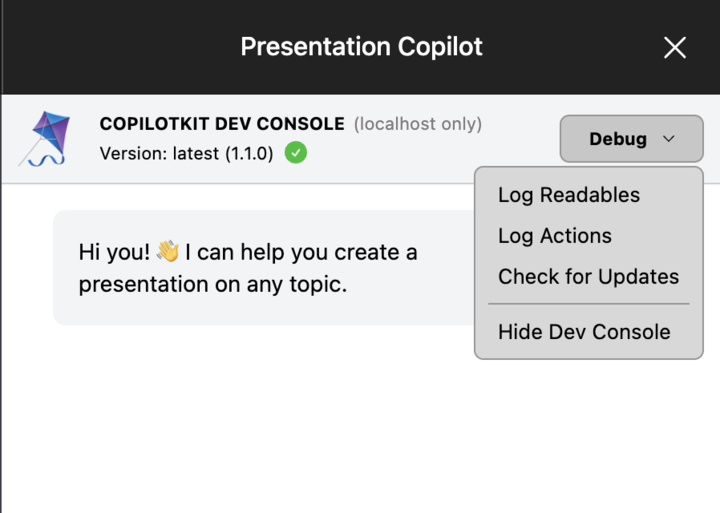
  • Log Readables - see which real-time state your app is making available to the Copilot
  • Log Actions - log the current actions your app is registering with the Copilot
  • Check Updates - find out if there are major library updates you should be aware of.
__wf_reserved_inherit

The dev console is enabled by default when running on localhost- and can also be shown or hidden manually. It is displayed at the top-right corner of the Chat UI.

Runtime enhancements with Groq adapter and constructor parameters middleware

Continuing to build on runtime improvements from last month, our adapter library now includes Groq support in addition to Google GenAI, LangChain, and OpenAI.  These service adapters make it easy to leverage the power of AI and LLM platforms in your copilot app with a standardized request and response format.

The runtime also got a significant update with middleware to enable developers to further customize their copilot app in novel ways. Our design philosophy for CopilotKit is ‘batteries included, and replaceable’. We aim to make CopilotKit buttery-smooth for common Copilot use cases; and also to make it adaptable to edge cases we haven’t specifically designed for.

The new middleware lets you pass your code to the Copilot Runtime - to be run in between critical framework-owned steps.

This deployment led to the next exciting feature below, made available by a contribution from the community!

New async operations available for RAG integration

While the CopilotKit messaging handling allowed for synchronized operations, this limited the ability in certain use cases such as when you need to log into databases for retrieval-augmented generation.

Thanks to Steve V S’  contributions, CopilotKit middleware now supports async functions, as well as optimized appending logic, and improved error handling. This is available in the self-hosted version of CopilotKit.

CopilotKit community contributions - thank you!

Speaking of contributors, the contribution guide is updated to make it easier for the community to submit issues, features, and documentation. It’s this community that helps make CopilotKit better for everyone.

Every Thursday join the CopilotKit team in our Discord office hours to catch up on the latest releases, and contributions, and for extra support on the Copilot apps you’re building.
Top posts

See All
Reusable Agents Meet Generative UIs
Anmol Baranwal and Nathan TarbertMarch 12, 2026
Reusable Agents Meet Generative UIsOracle, Google, and CopilotKit have jointly released an integration that standardizes how AI agents are defined, how they communicate with frontends in real time, and how they describe the UI they require. The integration connects three distinct layers. Oracle's Open Agent Specification (Agent Spec) provides a framework-agnostic way to define agent logic, workflows, and tool usage once and run it across compatible runtimes. AG-UI handles the live interaction stream between the agent and the frontend, keeping tool progress, state updates, and user interactions synchronized while the agent is executing. A2UI, developed by Google, allows agents to describe the UI they need - forms, tables, multi-step flows - as structured JSONL, which CopilotKit then renders automatically inside the host application. Previously, each of these layers required custom implementation per project. This release establishes a shared contract across all three, meaning agent developers can define the agent once, expose a standardized interaction stream, and have the frontend render structured UI surfaces without writing custom wiring for each tool or workflow. The practical impact is reduced integration friction across the ecosystem - agent runtimes and frontend clients that implement these standards can interoperate without lock-in to a specific framework or vendor.
The Developer's Guide to Generative UI in 2026
Anmol Baranwal and Nathan TarbertJanuary 29, 2026
The Developer's Guide to Generative UI in 2026AI agents have become much better at reasoning and planning. The UI layer has mostly stayed the same, and it is holding back the experience. Most agent experiences still rely on chat, even when the task clearly needs forms, previews, controls, or step-by-step feedback. Generative UI is the idea that allows agents to influence the interface at runtime, so the UI can change as context changes. This is usually done through UI specs like A2UI, Open-JSON-UI, or MCP Apps. We'll break down Generative UI, the three practical patterns, and how CopilotKit supports them (using AG-UI protocol under the hood).
Bring MCP Apps into your OWN app with CopilotKit & AG-UI
Anmol Baranwal and Nathan TarbertJanuary 22, 2026
Bring MCP Apps into your OWN app with CopilotKit & AG-UIToday, we are excited to announce CopilotKit’s support for MCP Apps. Now, MCP servers can finally ship an interactive UI that works out of the box in real agent applications.
Are you ready?

Stay in the know

Subscribe to our blog and get updates on CopilotKit in your inbox.