Eyebrow Background Glow

MCP Apps: Bring MCP Apps to your users!

AG-UI Goes Mobile: The Kotlin SDK Unlocks Full Agent Connectivity Across Android, iOS, and JVM

By Nathan Tarbert
November 4, 2025
AG-UI Goes Mobile: The Kotlin SDK Unlocks Full Agent Connectivity Across Android, iOS, and JVM

Mark Fogle’s recent contribution of the Kotlin SDK to AG-UI is a big step forward: developers can now integrate AG-UI directly into Android, iOS, and JVM environments through a single, unified SDK.

This means users can now connect to agents directly from mobile with no custom bridges, wrappers, or per-platform workarounds.

What it looks like in practice:

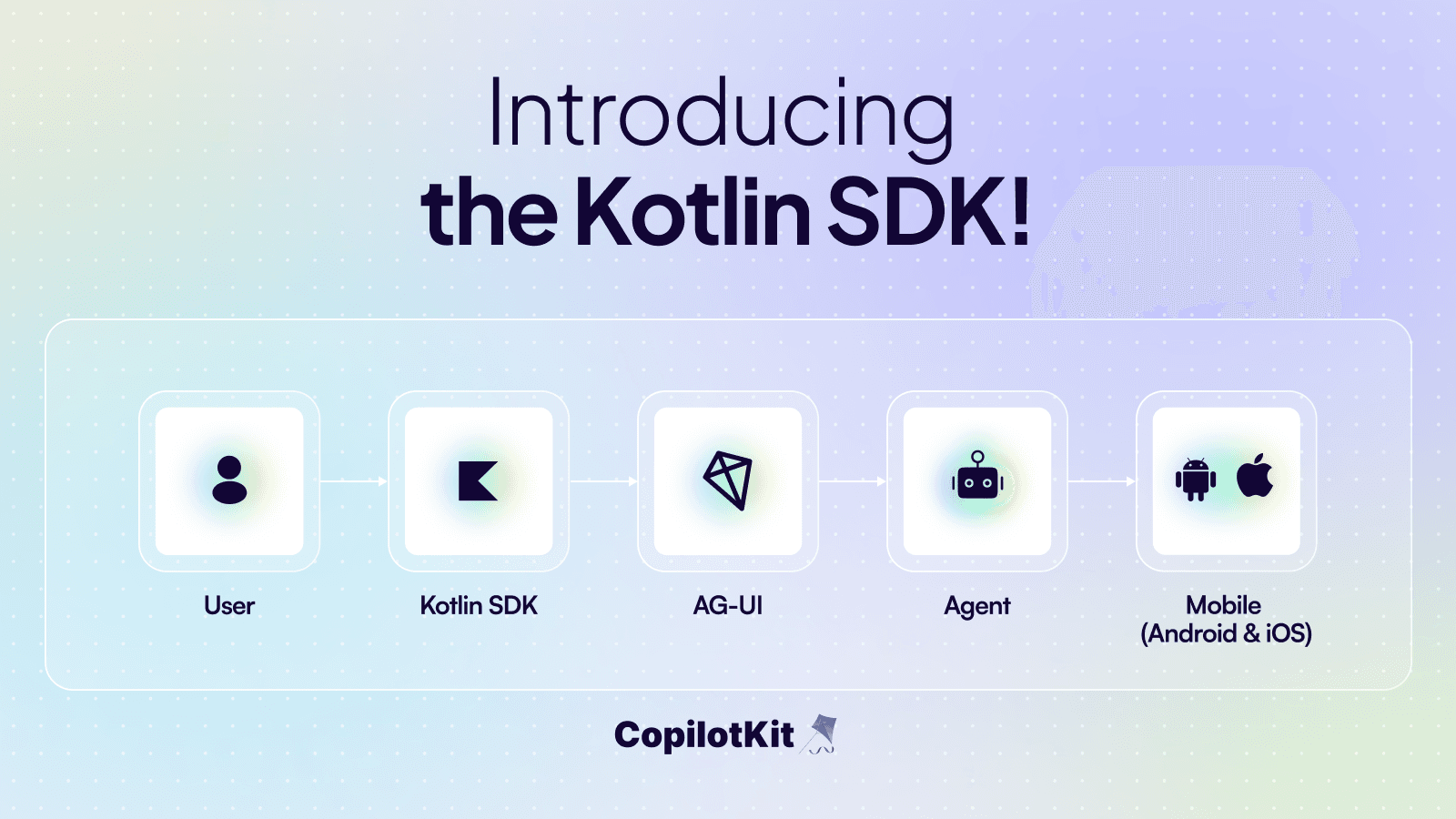
User → UI (Compose KMP / Swift / MDC) → Kotlin SDK → AG-UI → Agent → Android / IOS / JVM

This flow enables real-time agent interactions from native apps, instead of relying on browser-based clients or webviews. AG-UI now lives natively inside your mobile stack, powered by Kotlin’s multiplatform capabilities.

Why It Matters

Until now, AG-UI integrations were primarily web-first. That left mobile developers with either:

  • Building custom wrappers, or
  • Waiting for mobile SDK parity.

The Kotlin SDK eliminates both problems. You can now embed AG-UI agents in native mobile apps with full feature parity, minimal setup, and consistent behavior across all platforms.

Check out Mark's SDK walkthrough 👇

Technical Benefits

  1. Unified API surface → Same AG-UI methods across Android, iOS, and JVM.
  2. Native performance → No JavaScript bridge or runtime overhead.
  3. Consistent agent UX → Whether on mobile or desktop, the agent context and message flow remain identical.

What This Enables

  • On-device AI copilots that interact with app context in real time.
  • Cross-platform assistants that maintain session state between web, Android, and iOS.
  • Seamless integration into existing mobile UIs (Jetpack Compose, SwiftUI, etc.) through the AG-UI abstraction layer.

The Bigger Picture

This Kotlin SDK moves AG-UI closer to its goal: being the universal interface layer for agentic systems.

Developers can now connect users and agents anywhere-from a mobile app, web app, or JVM service-through a single, consistent pipeline.

Try It Out

Start building with the Kotlin SDK:

If you’ve been waiting to bring AG-UI agents to mobile, the time has arrived.


Don’t miss what’s next! Follow CopilotKit on Twitter for real-time updates and join our Discord to collaborate with fellow agent builders.

Happy building!
Top posts

See All
Reusable Agents Meet Generative UIs
Anmol Baranwal and Nathan TarbertMarch 12, 2026
Reusable Agents Meet Generative UIsOracle, Google, and CopilotKit have jointly released an integration that standardizes how AI agents are defined, how they communicate with frontends in real time, and how they describe the UI they require. The integration connects three distinct layers. Oracle's Open Agent Specification (Agent Spec) provides a framework-agnostic way to define agent logic, workflows, and tool usage once and run it across compatible runtimes. AG-UI handles the live interaction stream between the agent and the frontend, keeping tool progress, state updates, and user interactions synchronized while the agent is executing. A2UI, developed by Google, allows agents to describe the UI they need - forms, tables, multi-step flows - as structured JSONL, which CopilotKit then renders automatically inside the host application. Previously, each of these layers required custom implementation per project. This release establishes a shared contract across all three, meaning agent developers can define the agent once, expose a standardized interaction stream, and have the frontend render structured UI surfaces without writing custom wiring for each tool or workflow. The practical impact is reduced integration friction across the ecosystem - agent runtimes and frontend clients that implement these standards can interoperate without lock-in to a specific framework or vendor.
The Developer's Guide to Generative UI in 2026
Anmol Baranwal and Nathan TarbertJanuary 29, 2026
The Developer's Guide to Generative UI in 2026AI agents have become much better at reasoning and planning. The UI layer has mostly stayed the same, and it is holding back the experience. Most agent experiences still rely on chat, even when the task clearly needs forms, previews, controls, or step-by-step feedback. Generative UI is the idea that allows agents to influence the interface at runtime, so the UI can change as context changes. This is usually done through UI specs like A2UI, Open-JSON-UI, or MCP Apps. We'll break down Generative UI, the three practical patterns, and how CopilotKit supports them (using AG-UI protocol under the hood).
Bring MCP Apps into your OWN app with CopilotKit & AG-UI
Anmol Baranwal and Nathan TarbertJanuary 22, 2026
Bring MCP Apps into your OWN app with CopilotKit & AG-UIToday, we are excited to announce CopilotKit’s support for MCP Apps. Now, MCP servers can finally ship an interactive UI that works out of the box in real agent applications.
Are you ready?

Stay in the know

Subscribe to our blog and get updates on CopilotKit in your inbox.